
 |


Phenoliclaminate/Bakeliteboard hot Press( multi-layer hot press for insulating boards) is the primary piece of equipment used in the production of 3020/3021 paper-based phenolic laminates (bakelite sheets) and 3025 cotton-fabric-based phenolic laminates. It is a type of intermittent hydraulic multi-layer hot press that serves as the core machinery for curing and forming resin-impregnated substrates—such as paper or fabric—into laminated sheets through the application of heat and pressure.
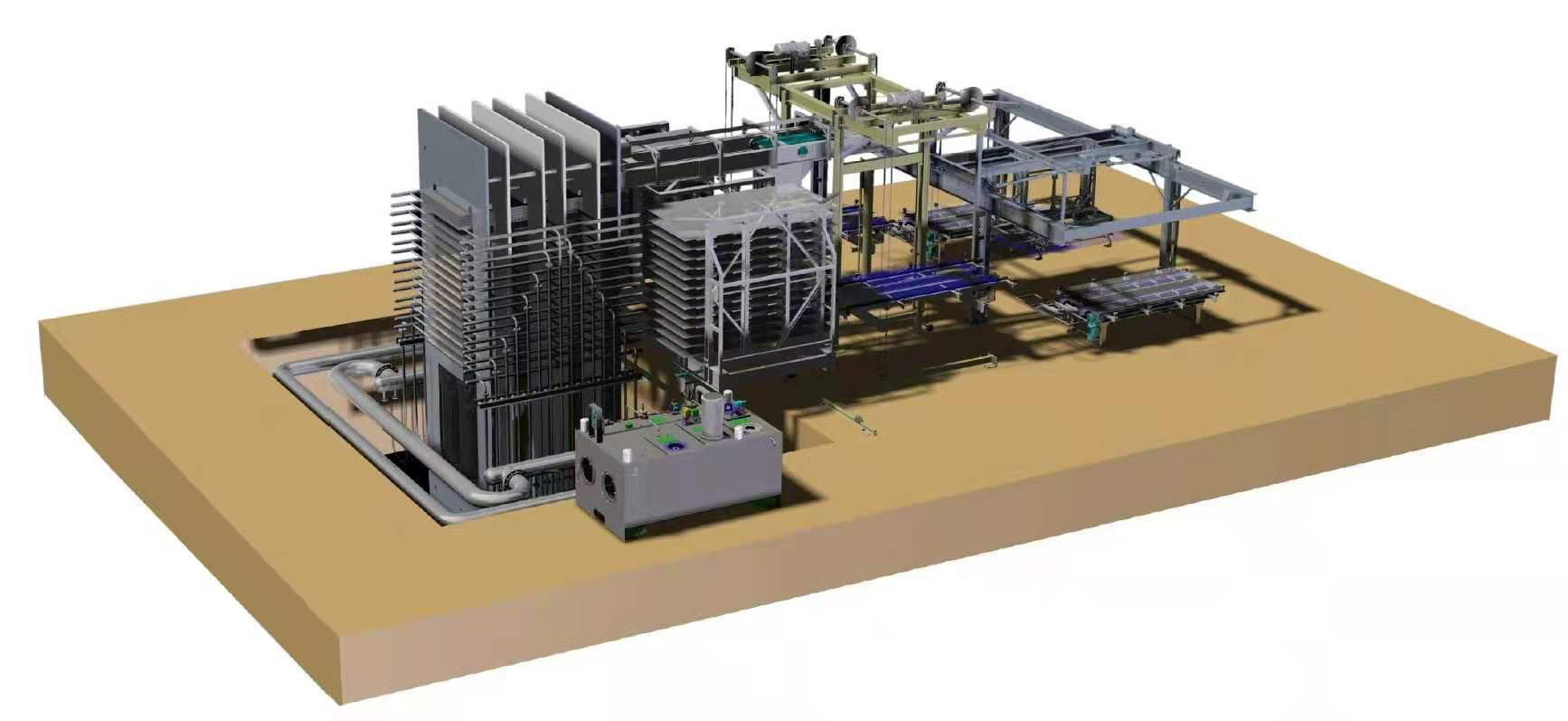
| Item | Parameters |
| Product size | 1020×2040mm / 1220×2440mm / 1300×2500mm Depends on customer requirement |
| Pressure | Paper-based substrate 3–7 MPa; cotton-fabric-based substrate 7–12 MPa |
| Layers | 5~20 layers |
| Temperature | Room temperatuer ~200℃ |
The operating principle is as follows: the stacked phenolic prepregs are placed into a press, where the heating platens raise the temperature to melt and liquefy the resin. Simultaneously, pressure is applied at a specific stage, allowing the resin to impregnate the fibers and expel both the air trapped between the layers and the water vapor generated by the condensation reaction, ultimately resulting in cross-linking and curing.
Designed to withstand immense, sustained pressure, this system prevents the frame from stretching or deforming and ensures the platens remain parallel.
Provides the force required for pressing; typically composed of a hydraulic power unit, cylinders, valve manifolds, and control circuits. Based on feedback from pressure sensors, the PLC automatically initiates pressure compensation if the pressure drops during the holding phase, ensuring the set pressure is maintained.
Heating can be achieved using steam, thermal oil, or electric heating elements. The internal piping design of the heating platens—such as a multi-inlet/multi-outlet circuit—is critical for achieving uniform temperature distribution. Controlled cooling is facilitated by circulating cooling water or cold oil.
Utilizes a PLC + HMI architecture. Key functions include multi-stage temperature and pressure profiling, venting sequence programming, cooling rate control, and fault alarming. Operators can select or edit specific process recipes tailored to different resin grades and material thicknesses.
Primary materials: Phenolic paper laminates (Bakelite sheets) and phenolic cotton-cloth laminates.
Insulation barriers for transformer oil, switch bases, terminal boards, and low-voltage insulation spacers.
PCB drilling backup boards, ICT (In-Circuit Test) fixtures, and positioning plates for tooling.
Gears, shaft sleeves, sliding blocks, bushings, mold clamping plates, and cushioning pads (primarily made from 3025-grade cotton-cloth laminates).
Workbench pads, thermal insulation pads, and fixture base plates.
Custom Precision-Machined Parts
Various structural insulation components processed via CNC.
(1) Supports "cold–hot–cold" pressing and cooling cycles
(2) Multi-stage programmable pressure and temperature profiles
(3) Uniform temperature distribution across the platen surface
(1) Multi-layer, batch-style operation with high per-cycle capacity
(2) Proven, mature solution with a moderate investment requirement
(3) Controllable energy consumption during operation
(1) Durable design for hot-pressing platens
(2) Flexible pressure application
Can be equipped with a vacuum enclosure; supports integration with automatic carts, robotic layup systems, and steel plate return lines to upgrade from a semi-automatic to a fully automated production line. Includes data acquisition capabilities, with support for MES integration for production traceability.


