
Views: 0 Author: Site Editor Publish Time: 2026-07-17 Origin: Site


In the manufacturing of decorative veneer, plywood, laminated wood (LVL), and various engineered wood products, defect detection remains the most critical phase dictating final product quality. It is deeply integrated into the entire production lifecycle—from initial grading and clipping to patching and final repair.
However, traditional detection methods are increasingly becoming the "weakest link" in modern mills, presenting two major bottlenecks:
Inconsistent Standards and Low Precision: Relying on manual inspection or legacy optical scanners often leads to missed defects, false rejects, and inconsistent grading due to operator fatigue or rigid software limitations.
Resource Waste and Escalating Energy Costs: When inferior raw materials fail to be identified early, they do more than just lower the overall yield. These defective panels proceed into high-energy processes like drying and hot pressing, causing severe hidden financial losses, wasting thermal energy, and directly impacting the mill’s overall profitability.
To directly address these industry pain points, hallmark, the renowned supplier of wood panel equipment and intelligent detection systems, has announced the successful deployment of its AI-Enhanced Defect Detection Solution in active production environments. Tailored specifically for modern engineered wood production lines, this solution elevates traditional scanning accuracy to an unprecedented level of intelligent automation.
At the core of this revolutionary solution is the highly acclaimed hallmark industrial analyzer. It seamlessly executes real-time veneer and panel inspection and grading across multiple production stages.
By instantly outputting critical production metrics—such as surface quality, moisture content, and structural strength—the hallmark analyzer integrates seamlessly with advanced visual detection technologies. This synergy establishes a comprehensive, automated data ecosystem that empowers mill operators to make informed, data-driven decisions.
The upgraded AI detection system is powered by proprietary deep learning models and cutting-edge industrial machine vision. This powerful combination grants the equipment unparalleled adaptability and intelligence:
Universal Adaptability: The system seamlessly adapts to various wood species, complex grain patterns, unpredictable surface conditions, and diverse factory lighting environments.
Intelligent Decision-Making: It accurately generates a highly precise, digital "defect map" (identifying knots, splits, voids, and discolorations) for every single sheet of veneer. This allows subsequent processes, such as clipping and patching, to be executed with pinpoint accuracy, drastically reducing the need for human intervention.
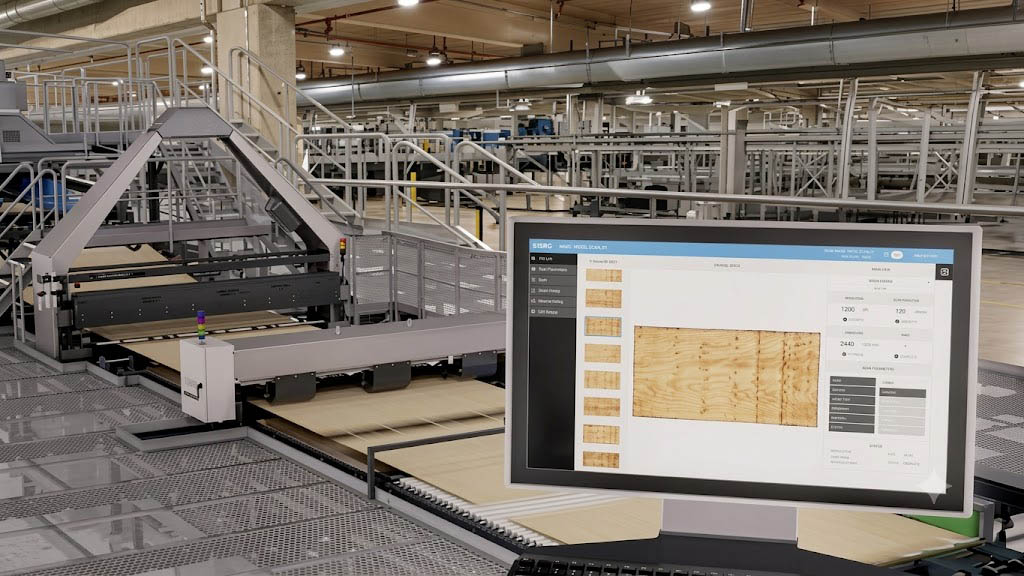
hallmark’s AI defect detection equipment does not merely improve product "quality"—it radically optimizes operational "efficiency." The system comprehensively covers critical operational nodes, including green veneer inspection, dry veneer grading, and final panel repair classification.
Core Value Proposition: The "Early Rejection" Mechanism
Utilizing high-precision AI recognition, the system proactively screens out inferior raw materials at the earliest possible stage. By preventing substandard panels from entering energy-intensive bottlenecks like the veneer dryer or the hot press, mills can significantly reduce raw material waste, cut down thermal and electrical consumption, and take a massive step toward energy-efficient production and carbon reduction.


