
 |


Epoxy Resin/Fiberglass Laminates Hot Press
This equipment is specifically designed to solidify the glass fiber cloth impregnated with epoxy resin under high temperature and high pressure, resulting in a laminated sheet with low porosity and uniform thickness.It is the core forming equipment for the production of FR4 epoxy glass fiber insulation boards, CCL copper-clad boards, and PCB multilayer boards.
The laminated semi-cured sheets (with copper foil attached) are fed into the hot press. The upper and lower heating plates are heated up to soften and melt the resin, while the hydraulic system applies pressure to compact the materials.
During the holding and pressurizing stage, the resin fully penetrates the fibers and expels air and volatile substances. Then, it is cooled and shaped under the holding pressure to obtain a dense laminated board.
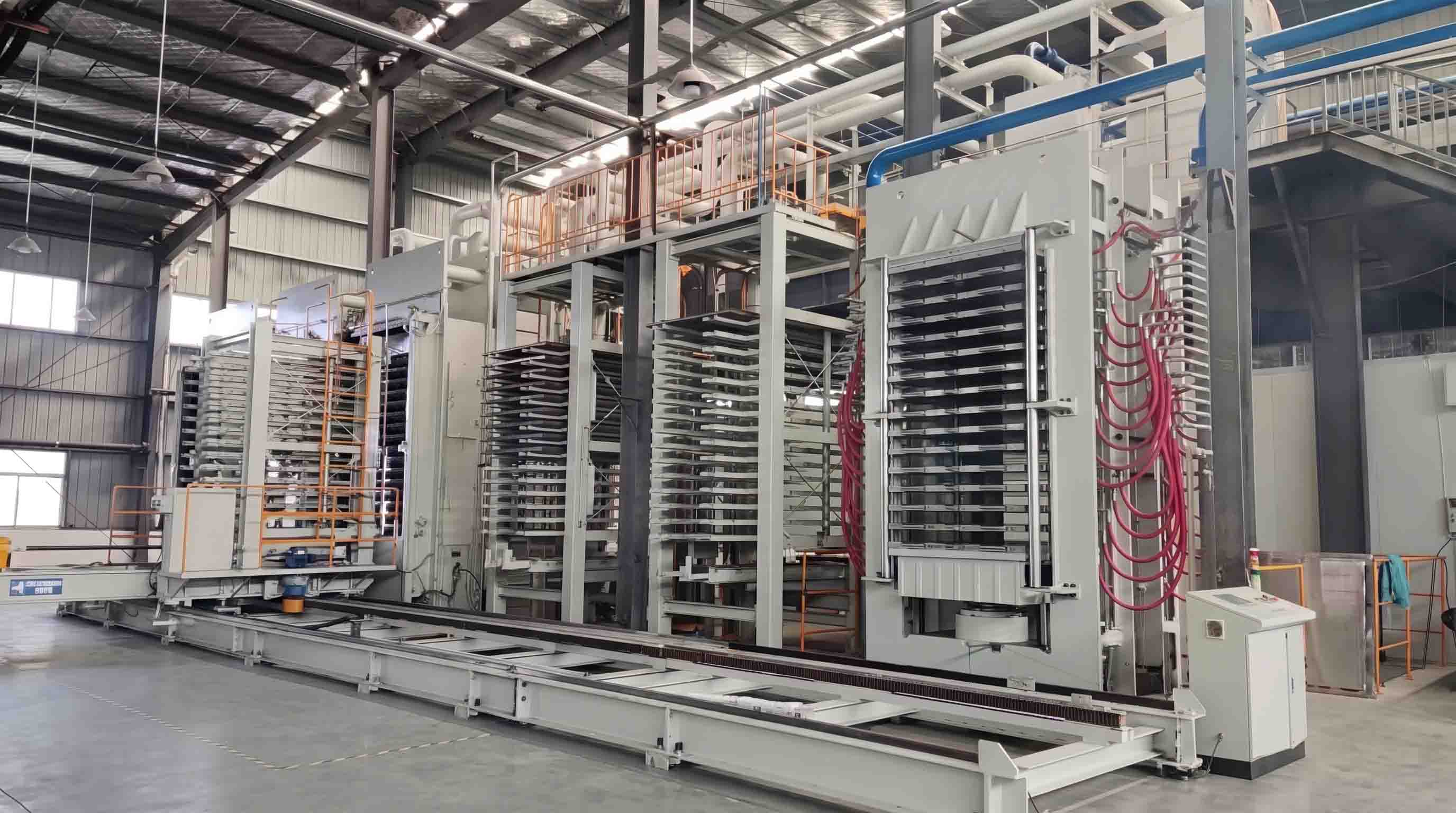
| Product Size | 1250×1400×50mm、1350×1550×55mm |
| Pressure | 2~10MPa |
| Layers | 4~24 layers |
| Temperature | 150℃~180℃,some Max. 260℃ |
The frame is made of welded structure, with high rigidity and capable of withstanding long-term high pressure, ensuring stable parallelism and flatness of the heated plate;
Made of Q235 or Q335 material, with internal drilled holes for circulating heat transfer oil or hot water; the surface is ground, with high requirements for flatness and parallelism, which determines the tolerance of the plate thickness;
Main hydraulic cylinder + hydraulic station, closed-loop pressure regulation, supports multi-stage pressure switching such as contact pressure → pre-pressure → full pressure → supplementary pressure, with gentle and controllable pressurization speed, preventing runaway of glue flow;
The mainstream is circulating heat transfer oil heating (uniform temperature control, suitable for long-term curing);
The entire pressing process is vacuumed, removing air, water vapor, and small volatile molecules of resin, eliminating bubbles, white spots, and delamination defects;
PLC + HMI touch screen, PID zone temperature control, capable of storing multiple pressing formulas (ordinary FR4, high Tg, halogen-free, copper-clad laminate, multilayer PCB); real-time records temperature, pressure, vacuum curves, supports data traceability, equipped with over-temperature, overload, and safety grating protection.
It is widely used in electrical insulation, new energy, PCB industry and composite material structural components.
FR4/3240 Epoxy Fiberglass Insulation Board (Copper-Free)
Insulation partitions for switch cabinets, insulation components for transformers, insulation pads for new energy batteries, work tools and fixtures, insulation structural components for motors
CCL Copper-Clad Board (Single Side / Double Side with Copper Foil)
PCB circuit board substrate, used in industrial control, photovoltaic inverters, servers, consumer electronics
Multilayer PCB Boards
High-grade circuit boards with 4/6/8 layers, computing power boards, mainboards, automotive electronic boards
Special Flame-Retardant, High-Temperature Resistant Epoxy Fiberglass Sheets
For rail transit, energy storage, power equipment
Optional vacuum lamination, effectively eliminating bubble and delamination defects, resulting in high product yield
Thermal oil circulation heating, ensuring uniform board surface temperature and good consistency in curing
Programmable multi-stage temperature-pressure curves, precisely matching FR4, CCL, and high Tg board manufacturing processes
Compression cooling process, with minimal internal stress in the board and low warpage deformation
High-precision grinding hot plate + rigid frame, ensuring uniform thickness and stable tolerance
Multi-layer open batch lamination, high production efficiency, suitable for large-scale mass production
Formula can be switched in one click, compatible with lamination of insulating boards, copper-clad boards, and multi-layer PCBs
Automatic storage of process data, meeting the requirements for quality traceability
It is used for the bonding and curing of epoxy glass fiber semi-cured sheets, and can produce 3240 epoxy insulation boards, FR4 insulation boards, single-sided / double-sided CCL copper-clad boards, PCB multilayer board inner laminated boards, new energy insulation pads, jigs, etc.
- Vacuum model (mainly recommended): Vacuum chamber, vacuum degree ≤ 10 mbar; suitable for FR4, CCL, thin sheets, high Tg / halogen-free materials, PCB multilayer boards, bubbles, delamination are few, and the yield is high; the cost is higher, and it requires a thermal oil furnace + vacuum unit as a companion.
- Non-vacuum model: No vacuum chamber, relying on high-pressure exhaust; only suitable for thick 3240 ordinary insulation boards, not suitable for thin copper-clad boards, high-grade PCBs, prone to air holes and white spots.
Tonnage is the total output force of the cylinder; surface pressure is the unit area pressure of the board stack (the core of the process).
The conventional vacuum process for FR4/CCL is 2.0–5 MPa; for 3240 without vacuum, it is 5–10 MPa.
First, determine the size of the hot plate surface, and then calculate the required tonnage of the press machine. It is not necessarily the larger the better.
The industry mainstream is thermal oil circulation heating, with a small board surface temperature difference and stable long-term insulation, suitable for FR4 curing long processes; electric heating is mostly used in small test press machines, with fast heating but poor board surface uniformity and high energy consumption, not suitable for mass production lines.
Answer: The most common reason is that the volatile substances in the prepreg are too high or the pre-press exhaust is insufficient. Solutions include: appropriately extending the preheating time, applying contact pressure (low pressure) during the resin softening stage and maintaining it for a period of time to allow the volatile substances to escape, and then increasing the full pressure. If using a vacuum hot press machine, this problem will be significantly alleviated.
Answer: The core principle is to maintain pressure and cooling. After curing, if the heat plate is immediately unloaded and removed, the board will cool in a free state due to inconsistent internal and external contraction, resulting in warping. The correct approach is: while maintaining pressure, let the heated plate cool to below 60°C (or close to room temperature) before opening the mold and removing the part. The cooling rate should not be too fast to avoid thermal stress.
Answer: First, check if the parallelism of the hot press plate and the height of the limit block are consistent. Secondly, if the prepreg itself has "one side old, one side tender" (soluble resin content is uneven), it will also cause uneven flow. In addition, if the hot plate of the press machine has a central depression due to long-term use, it will also cause the middle to be thin, and regular maintenance is required.


